

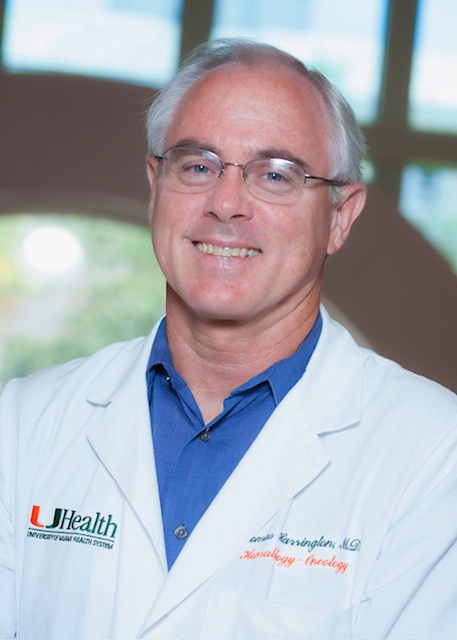
Son of William Harrington, a legend in hematology, whose legacy has had a profound influence on his own career. His work has focused on the management and study of non-malignant hematology, with particular emphasis on the care of patients with sickle cell anemia, bleeding disorders, and thrombotic diseases. He serves as the primary hematologist at Jackson Memorial Hospital, where he attends on the inpatient consult service and specialty clinics for sickle cell, hemophilia, and general hematology.
In the fields of sickle cell disease and hemostatic disorders, he has been actively involved in co-management and numerous intervention trials in collaboration with his pediatric colleagues. Given that both sickle cell and hemostatic diseases are congenital, these partnerships have been crucial for providing continuity of care and facilitating the transition from pediatric to adult care. His role as the principal investigator at the University of Miami for the Sangamo (now Pfizer) SB-525-1603 AAV viral vector-directed Factor VIII gene therapy for hemophilia further highlights his commitment to advancing treatment options. He and his pediatric colleagues are also in the approval process for additional gene therapy studies for sickle cell anemia.
In addition to his research work, he runs the outpatient sickle cell and hemophilia clinics and attends the fellows’ weekly continuity clinic. His University of Miami clinic also handles a broader range of hematology cases. He is an active educator, frequently lecturing on sickle cell disease and bleeding disorders to Internal Medicine house staff, medical students, and professionals from various specialties such as Emergency Medicine, Psychology, and Obstetrics/Gynecology. His lectures extend to other groups within the Jackson system and at FIU.
Inspired by his father, he has always felt a deep sense of gratitude and motivation. William Harrington made seminal contributions to the field, particularly with his self-experimentation in ITP, and was renowned not only for his research but also for being an inspiring bedside physician, teacher, and visionary. One of his greatest legacies is the Latin American training program, which has brought outstanding physicians to train in the US. Many of these physicians have returned to their home countries to become leaders, while others who have remained in the US have built academic careers and continue to support Latin America in various ways.